What counts as speed to lead?
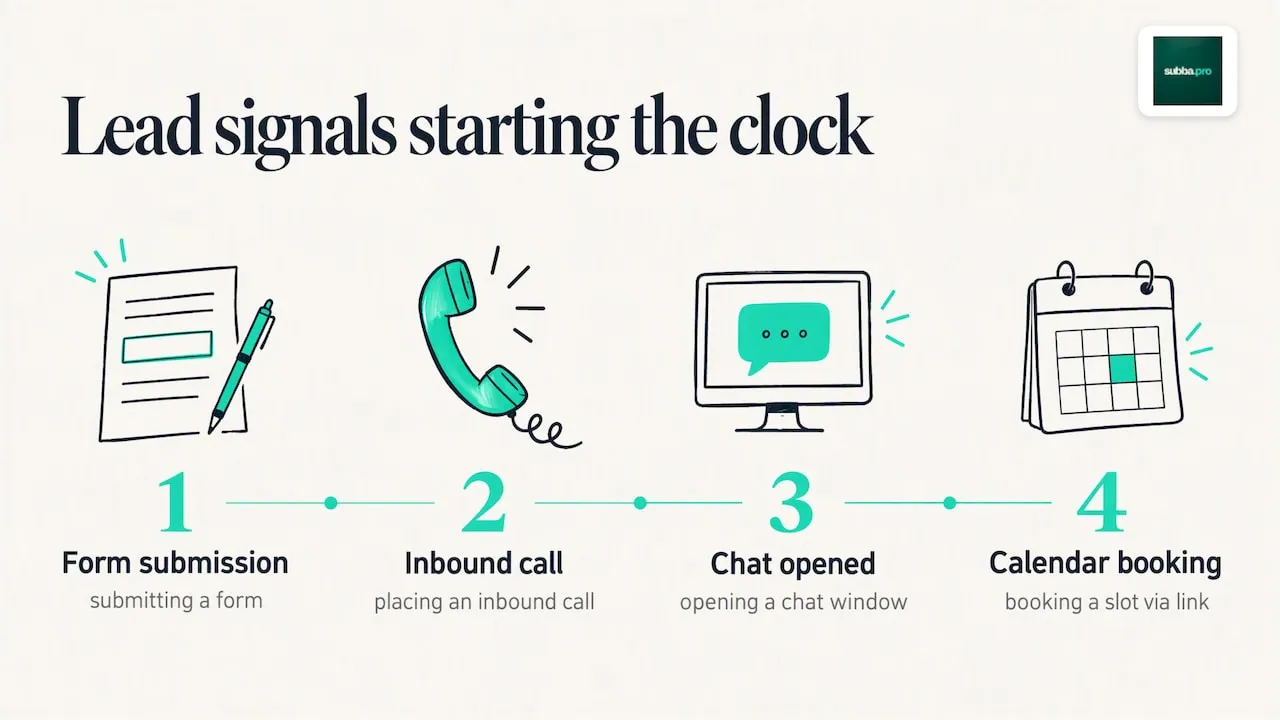
Speed to lead only means something once you agree on what starts and stops the clock. The clock starts the moment a prospect takes an action that signals genuine interest: submitting a form, placing an inbound call, opening a chat window, or booking a slot through a calendar link. Each of these is a different kind of signal, and treating them identically can distort your numbers.
The harder question is what counts as "first contact." An automated acknowledgement, a text confirming "we've got your enquiry and will call you back," is useful and reassuring, but it is not meaningful contact. Meaningful contact happens when a human, or a system capable of genuine two-way conversation, engages with the specifics of what the prospect asked for. A booking confirmation email is not the same as someone discussing dates, pricing or availability.
This distinction matters more for some enquiry types than others. A demo request from a software buyer, a quote request from a tradesperson's website, or a booking attempt for a fully committed slot are all high-intent signals, and the clock on these should be treated as urgent from the first second. A newsletter signup or a content download sits at the other end of the scale: useful to capture, but not worth the same panic if it takes an hour to follow up.
Getting this definition right across your team avoids a common trap: reporting a fast "response time" that is really just an autoresponder, while the prospect still waits hours for someone to actually answer their question. Align your sales and marketing teams on one shared definition before you start measuring anything, because inconsistent definitions make every dashboard that follows untrustworthy.
Why response speed matters more than most teams think
The evidence here is consistent and, for most sales teams, uncomfortable. Long-running analysis from the Lead Response Management study shows that both the odds of making contact with a lead and the odds of qualifying that contact fall sharply as response time increases, with the steepest drop-off happening in the first few minutes after an enquiry comes in. Waiting even a short while before the first call can mean the difference between reaching a prospect at all and never hearing back.
Lead interest decays fast after the first signal of intent, according to Harvard Business Review's analysis of online sales leads, which found that the probability of qualifying a lead drops significantly within a short window after it arrives. The explanation is not complicated: a prospect who fills in a form is usually comparing you with two or three competitors at the same moment, and whoever answers first often wins the conversation before anyone else even picks up the phone.
What does this mean in practice? Consider a typical volume of enquiries landing on your website in a week:
- A meaningful share will go to whichever business replies first, regardless of price or reputation.
- Each hour of delay reduces your realistic chance of making contact at all.
- Leads that go unanswered for a working day are, for most purposes, cold.
The business impact is not abstract. If your team answers within minutes rather than hours, you are not just being polite, you are protecting a conversion rate that depends on timing as much as on product fit or pricing.
What is a realistic target response time?
Once you accept that speed matters, the next question is: speed to what? The honest answer depends on the channel and the intent behind the enquiry, but a useful starting framework separates the "golden window" from everything else.
- High-intent enquiries (demo requests, quote requests, booking attempts) deserve an instant automated acknowledgement within seconds, followed by a human touch as soon as realistically possible, ideally inside the same working hour.
- Medium-intent enquiries (pricing questions, general callback requests) can tolerate a same-day response without losing much ground, provided the first touch is prompt enough to keep the prospect engaged.
- Low-intent enquiries (newsletter signups, content downloads) fit comfortably into an automated nurture sequence over several days.
Channel choice shapes what "ideal" actually looks like. A phone enquiry implies the prospect wants to talk now, so a missed call followed by a same-day callback already feels slow to them. A web form carries more patience built in, but only a little: the prospect is often filling in the same form on your competitor's site in the next browser tab. Chat sits closest to the phone in urgency: anyone typing into a chat widget expects a reply within the conversation, not an email tomorrow.
The practical takeaway is to stop treating "fast" as one number. Build staged targets that match urgency to channel, and make sure your team knows which enquiries deserve the fastest possible reaction.
How to shorten your response time, step by step
Improving speed to lead is less about buying new software and more about redesigning the path a lead takes from the moment they click submit. The following sequence works for most small and mid-sized teams.
- Tighten your intake form. Ask only for what you need to triage the enquiry: name, contact method, a one-line description of what they want. Every extra field is a chance for someone to abandon the form before you even see it.
- Add enrichment where it's cheap. Pulling in the referring page, the service they clicked from, or their rough location helps you route the enquiry without a phone call just to ask basic questions.
- Write triage rules in advance. Decide which enquiry types go straight to a person, which can be handled by an automated reply with a booking link, and which can wait for a nurture sequence, before the leads start arriving, not after.
- Switch on instant acknowledgement. A text or email that confirms receipt and sets expectations ("we'll call you within the hour") reduces the anxiety of waiting and buys you a little goodwill if the human follow-up takes a few extra minutes.
- Put a booking link in that first message. Letting a prospect pick their own slot removes an entire round of back-and-forth and often converts faster than waiting for a callback.
- Set SMS or call triggers for your highest-value leads. A missed-call alert or an SMS nudge to the assigned team member means nobody discovers an enquiry an hour late because they were away from their inbox.
- Use calendar auto-assignment for busy teams. Round-robin or skills-based routing avoids the common failure where every lead gets forwarded to the one person who happens to be free, regardless of whether they're the right fit.
- Design your SLA around realistic staffing. An on-call rota, even an informal one, means someone is always responsible for the next 30 minutes of enquiries, not "whoever notices first."
- Build a clear handoff process. When a lead moves from an automated first touch to a human, that handoff needs the enquiry's full context attached, not a cold restart of the conversation.
- Test and iterate. A/B test your acknowledgement wording, your routing rules and even the order of questions on your form, then measure which version actually shortens the time to meaningful contact.
Pro Tip: Start with your highest-intent lead source first (usually quote requests or bookings) rather than trying to fix every channel at once; a narrow, measurable win builds the case for wider rollout.
For a sector-specific example of this kind of intake redesign, see how subba answers and books calls for heating engineers, a trade where missed calls are especially costly.
Which channels actually speed things up?
Different channels carry different trade-offs between speed, cost and the effort needed to set them up properly.
- Phone is the fastest channel for building trust and resolving complex questions, but it needs a person available to answer, or a system that can hold a genuine conversation, otherwise missed calls become your biggest leak.
- SMS gets opened and read within minutes for most recipients, making it a strong choice for instant acknowledgements and appointment reminders, though it suits short messages rather than detailed explanations.
- Email is the easiest to automate at scale and works well for confirmations and follow-ups, but it is the slowest channel for getting a genuine reply, since prospects check it less urgently than a text.
- Web chat matches the urgency of a phone call for prospects already on your site, and a quick reply there can convert a browsing visitor before they leave the page.
- Booking links remove a channel entirely by letting the prospect choose their own slot, which works well paired with any of the above as the next step after first contact.
A sensible sequence for a high-intent enquiry might be: instant SMS acknowledgement with a booking link, followed by a call attempt within the hour if the prospect hasn't booked themselves. Behind the scenes, this usually relies on a few technical building blocks: a webhook that fires the moment a form is submitted, an SMS gateway to send the acknowledgement, and a calendar URL that lets the prospect self-serve a time slot without waiting for anyone.
How to measure and keep improving your response time
None of the changes above mean much unless you can see whether they're working. A small set of KPIs, tracked consistently, tells you most of what you need to know.
- Median response time, measured from the triggering event to first meaningful contact, not the automated acknowledgement.
- Percentage of leads contacted within your target window, which shows whether your process holds up under real volume, not just on quiet days.
- Contact rate, the share of leads you actually reach at all, which tends to track closely with how quickly you attempt contact.
- Conversion rate, segmented by how quickly each lead was contacted, so you can see the pattern for yourself rather than taking it on faith.
Segmenting these numbers by channel, campaign and lead source usually reveals uneven performance that a single blended average hides. A paid search campaign might convert fast leads brilliantly while your organic enquiries sit for hours because nobody owns that queue. Reporting cadence matters here too: daily alerts for anything breaching your target window catch problems before they become a pattern, while a weekly trend review is where you decide whether a process change actually moved the needle.
Staying compliant while responding fast
Responding quickly with automated texts or emails still has to respect UK marketing law, and this is where speed and compliance can pull in different directions if you are not careful. Under ICO guidance on electronic and telephone marketing, automated electronic marketing messages and certain automated calls require clear, affirmative consent, with a narrow "soft opt-in" exception for existing customers under specific conditions. This matters directly for speed to lead: an instant automated acknowledgement confirming receipt of an enquiry is generally fine, but an automated marketing message pushing a related product needs its own lawful basis.
A practical checklist keeps this manageable:
- Make consent for marketing contact clearly separate from consent to simply respond to the enquiry itself.
- Record when and how consent was given, not just that it was given.
- Give every automated message a straightforward way to opt out.
- Keep a retention policy for enquiry data so it is not held indefinitely once the lead goes cold.
There is no central do-not-contact register covering texts and emails in the UK, which means the responsibility sits entirely with your own records and opt-out processes, not an external list you can check against.
Using an AI receptionist to close the gap responsibly
An AI receptionist service is one practical way to close the speed to lead gap without stretching your team past breaking point. An AI receptionist service can answer enquiries by phone, web chat or booking form, reply in the business owner's own tone and style rather than a generic script, and handle the booking and reminder steps that usually eat up the most admin time.
The sensible rollout is staged, not instant. Start by letting the system draft responses for your review, so you can see what it would have said before you hand over full control. Move to partial automation for your most predictable enquiry types first, bookings, availability questions, simple quote requests, while keeping a human fallback for anything sensitive, ambiguous or outside the usual pattern. This keeps the personalisation and the consent safeguards intact while still cutting the time a prospect waits for a first reply. For a local view, see how subba works for businesses in London and Leeds.
Where most speed to lead programmes go wrong
If I had to boil down a speed to lead programme into three priorities, they'd be these. First, fix your highest-intent flow before anything else: the quote request or booking attempt that already wants to say yes deserves your fastest, most reliable response, long before you touch your newsletter nurture sequence. Second, measure every change before you scale it. It is tempting to automate everything at once, but a routing rule that looks sensible on paper can quietly misfire for a whole category of leads if nobody checks the numbers for a week.
Third, resist the urge to automate your way through anything sensitive or regulated. The genuine win in speed to lead comes from removing friction, not from removing judgement. Teams that get this balance right tend to treat automation as a way to buy time for a human conversation, not a replacement for one.
Roland
A practical next step: instant intake without the overheads
Building every piece of this playbook in-house, intake forms, routing rules, SMS triggers, booking links, compliance checklists, takes real engineering time most small teams don't have spare. Some AI receptionist services cover that ground in one subscription: they answer enquiries across phone, web chat and booking forms the moment they land, reply in your own voice rather than a generic script, and handle bookings and reminders automatically, with no commission taken on the bookings they bring in.
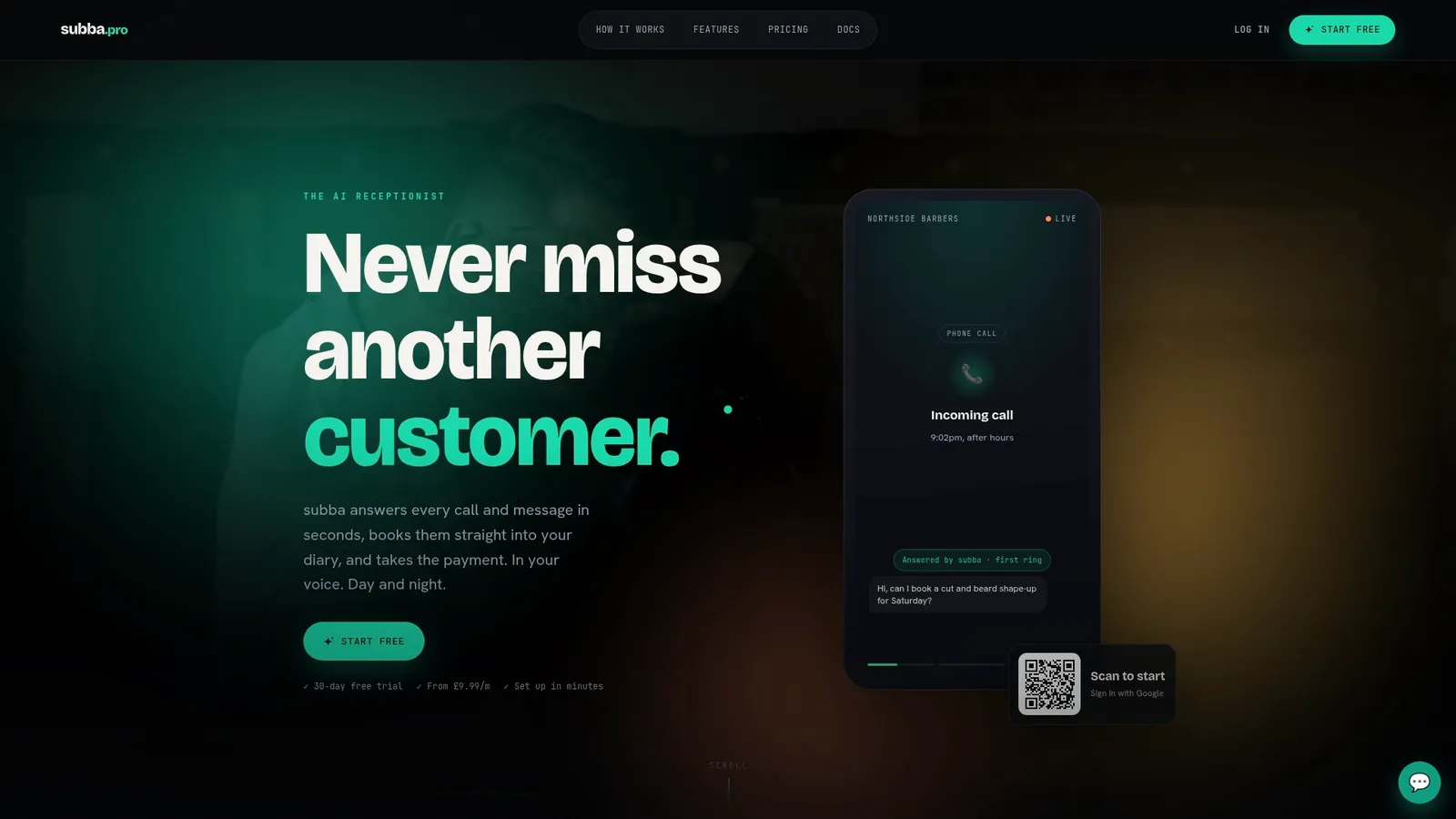
Every feature sits under one monthly price rather than scattered across separate tools, starting with the Starter plan at £9.99 a month, with Pro and Studio tiers available as your enquiry volume grows, and optional phone and SMS add-ons for teams that want a wider reach. If missed enquiries are costing you bookings right now, take a look at the full feature set and see which plan fits your volume of enquiries.